This week, some of the world's most important economic policymakers are gathering in Asheville, North Carolina — an unusually fitting place to discuss a provocative argument raised by Wall Street Journal columnist Greg Ip: the world may need something resembling a modern-day Plaza Accord to deal with China's undervalued yuan and enormous trade surplus.
Finance ministers and central bank governors from the G20 meet in Asheville August 31 through September 1, following meetings of their deputies over the weekend.
The original Plaza Accord was reached in 1985, when the United States, Japan, West Germany, France, and the United Kingdom coordinated action to bring down an overvalued U.S. dollar. Ip argues that today's problem runs in the opposite direction: China's currency is undervalued, giving Chinese producers a significant price advantage in world markets.
Why should anyone in Raleigh, Asheville, Charlotte, or elsewhere in North Carolina care? Because this is not an abstract debate about foreign-exchange markets. In 2025, North Carolina sold about $6.7 billion in goods to China. That means decisions about currencies, tariffs, and trade made in Beijing and Washington can have very real consequences for businesses, workers, and consumers in our state.
Why the Value of the Yuan Matters
China does not allow its currency to float as freely as the U.S. dollar. The Chinese government manages the yuan and maintains significant controls over capital moving into and out of the country. When the yuan is relatively weak against the dollar, Chinese products tend, all else equal, to become less expensive for American purchasers. The reverse is also true: American goods become relatively more expensive for Chinese purchasers.
Imagine a North Carolina company selling machinery, chemicals, pharmaceuticals, agricultural products, or other goods into China. If the yuan appreciates against the dollar, a Chinese customer needs fewer yuan to purchase the same dollar-priced North Carolina product. A stronger yuan can therefore make North Carolina exports more competitive in China while making Chinese exports relatively more expensive in the United States.
The scale of the issue is remarkable. China recorded a goods trade surplus of nearly $1.2 trillion in 2025, and the Wall Street Journal reports that Goldman Sachs projects a surplus of roughly $1.2 trillion again this year. Economists disagree about exactly how undervalued the yuan is — the Journal cites Goldman Sachs at about 19 percent and economist Brad Setser at about 35 percent. The International Monetary Fund's estimate is more conservative, placing the undervaluation of China's 2025 real effective exchange rate roughly between 12 and 21 percent, with a midpoint around 16 percent. Different methodologies produce different answers, but they point toward the same underlying issue: China's exchange rate and broader economic imbalances have made Chinese production unusually competitive in world markets.
Is China "Cheating" — or Just Playing a Different Game?
It is tempting simply to call this currency manipulation. But precision matters. The U.S. Treasury does not currently formally designate China a "currency manipulator." China does, however, remain on Treasury's Monitoring List. Treasury has specifically criticized China's lack of transparency concerning its foreign-exchange policies and warned that attempts to resist yuan appreciation through formal or informal intervention could support a future manipulation designation.
The broader problem also extends beyond direct currency intervention. China combines very high savings, weak household consumption, enormous manufacturing capacity, extensive industrial policy, and a financial system in which the government exercises considerably more control than governments in most market economies. The IMF itself has concluded that China's external position is stronger than would be justified by economic fundamentals and desirable policies.
So the real question is larger than whether Beijing is literally buying or selling currency on a particular day. How should market economies respond when another major trading nation operates an economic system that can systematically distort international prices? Ignoring those distortions is not necessarily free trade. But neither is permanent protectionism.
Could Tariffs Be Used as Leverage?
This is where the Wall Street Journal argument becomes particularly interesting. Tariffs are often discussed as though we must decide whether they are simply "good" or "bad." The real question should include how they are being used.
Permanent tariffs are a dangerous economic instrument. They can raise costs for American consumers, increase costs for American manufacturers using imported components, invite retaliation against American exporters, disrupt supply chains, and protect politically favored industries from competition.
But tariffs can also potentially serve as negotiating leverage. The United States and other major economies could effectively tell China: allow meaningful appreciation of the yuan and begin correcting the underlying economic imbalance, and the tariffs come down. That is fundamentally different from saying tariffs themselves are the objective. The ultimate goal would be fewer distortions and freer trade.
The Trump Dilemma
There is an important problem with that strategy. President Trump has embraced tariffs for purposes extending beyond negotiating concessions from China. He has promoted them as tools for protecting American industry, encouraging domestic production, raising revenue, and obtaining leverage over trading partners.
That creates an interesting negotiating dilemma. If tariffs themselves become a desired permanent policy, can they still be traded away for something potentially more valuable? Suppose China were considering a significant appreciation of the yuan. Beijing would reasonably ask: if we undertake this difficult adjustment, will Washington actually remove the tariffs? If China believes the tariffs will remain regardless of what it does with its currency, its incentive to make the deal diminishes substantially. Negotiating leverage is most valuable when you are willing to exchange it for what you actually want. That is precisely one of the obstacles Greg Ip identifies.
Why America Probably Cannot Solve This Alone
The Plaza Accord provides another lesson: the United States did not act alone in 1985. Five major economies coordinated their policies. China today sells enormous quantities of manufactured goods not only to America but also to Europe, Japan, and much of the rest of the world, and those economies increasingly confront the same underlying imbalance.
Collectively, the United States, Europe, Japan, and other advanced market economies represent an enormous share of China's foreign customers. Working together could therefore provide much greater leverage over Beijing than unilateral American action. But that produces another irony: if the United States imposes tariffs on its allies as well as China, those governments may become less willing to cooperate with Washington in a coordinated effort toward China. Tariffs can therefore create leverage while simultaneously making it harder to assemble the international coalition needed to use that leverage most effectively.
Why North Carolina Should Care
North Carolina is deeply connected to international commerce. In 2025, our state sold approximately $8.6 billion in goods to Canada, $6.7 billion to China, $5.3 billion to Mexico, $2.0 billion to France, and $1.2 billion to Germany. Altogether, North Carolina exported a record $43.8 billion in goods worldwide in 2025. Manufactured products accounted for $41.5 billion of those exports — chemicals alone accounted for $17.7 billion, followed by machinery, transportation equipment, computers and electronics, and electrical equipment.
Those numbers represent businesses, jobs, investment, and communities. So when economists debate China's exchange rate, the consequences eventually reach North Carolina. They can affect whether a North Carolina manufacturer wins an overseas contract. They can affect what a Raleigh business pays for imported components. They can affect farmers and exporters. They can affect consumers. And they can influence where companies decide to invest and manufacture.
The Bigger Question
The debate over China should not be reduced to two slogans: "Tariffs are good." Or: "Free trade means doing nothing." Neither is adequate.
The more important question is whether international commerce is actually occurring under reasonably competitive market conditions. If China's currency and economic policies contribute to a substantially undervalued exchange rate and enormous export surpluses, simply ignoring those distortions does not necessarily produce free trade. But replacing Chinese distortions with permanent American tariffs creates a different set of distortions.
The challenge is to find the least damaging tools capable of restoring more genuinely competitive markets. One possibility is targeted, temporary tariffs used as negotiating leverage, preferably in cooperation with other major market economies, in exchange for meaningful currency appreciation and broader economic rebalancing. And then the tariffs should come down.
Making Economics Understandable — and Relevant to North Carolina
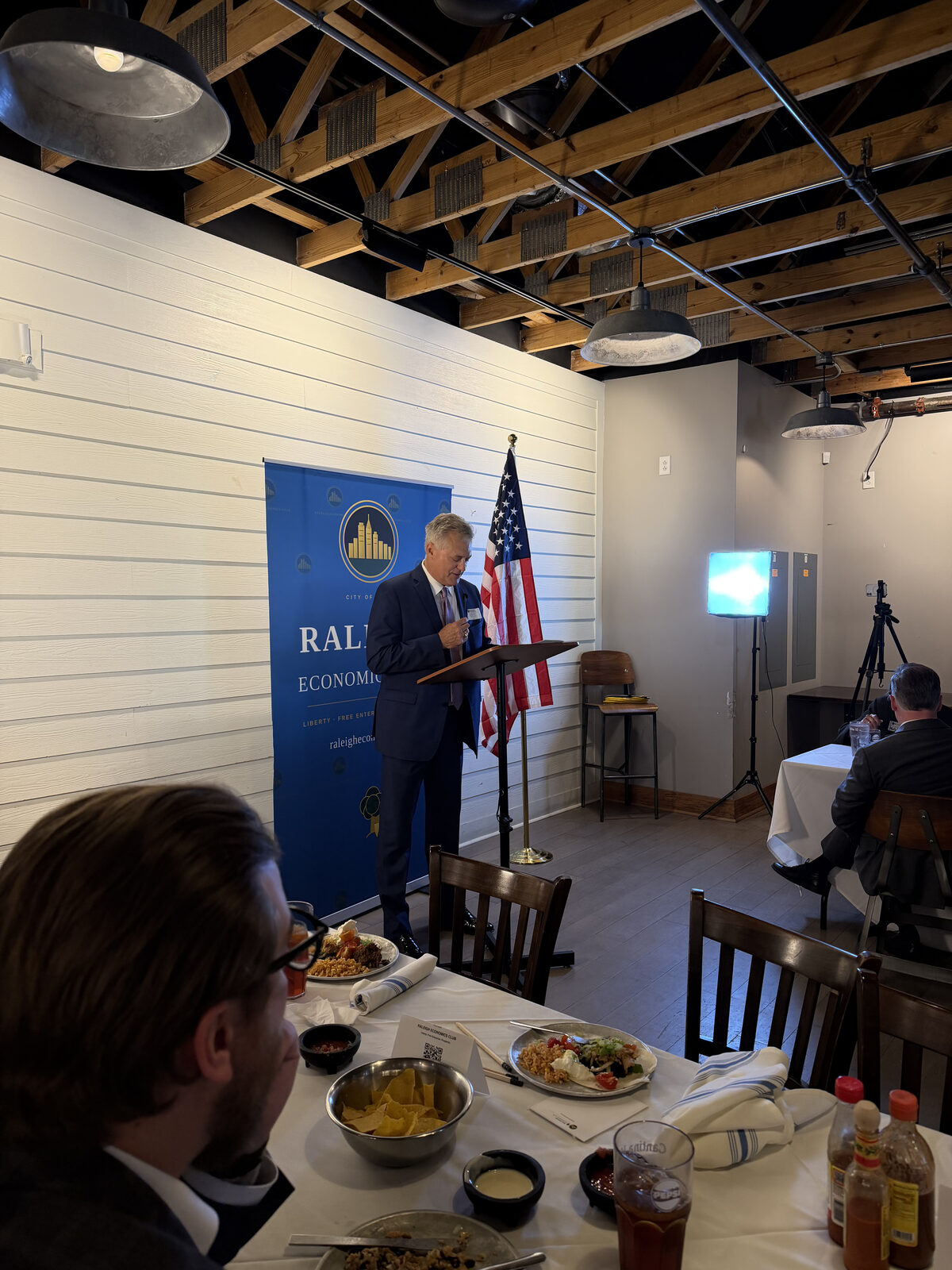
This issue illustrates exactly why we created the Raleigh Economics Club. Economics connects the local with the global. A currency decision made in Beijing can affect a manufacturer in North Carolina. A tariff imposed in Washington can affect a business in Raleigh. A meeting of finance ministers in Asheville can address economic forces affecting companies and consumers throughout our state.
The Raleigh Economics Club wants to make those connections understandable. Our purpose is not merely to repeat economic slogans. We want business people, entrepreneurs, academics, students, policymakers, professionals, and interested citizens examining important questions together: What actually produces prosperity? How do markets work — and what happens when governments distort them? How should America defend free enterprise when other countries operate under different economic rules? And how do international economic policies ultimately affect North Carolina?
Economics can be complicated. It should not be incomprehensible. Those are the kinds of issues and conversations the Raleigh Economics Club exists to explore.
REC is a 501(c)(3) nonprofit that publishes general commentary and educational content about economics, free of charge, for the purpose of public discussion. Nothing in this article — or in any REC blog post, comment, social media content, or statement by a speaker, adviser, or other affiliated individual — constitutes financial, investment, legal, or tax advice, and none of it is tailored to any individual's circumstances. Speaker views are the speaker's own and are not pre-approved, controlled, or adopted by REC. No contribution to REC constitutes payment for advice; contributions support REC's broader mission of promoting liberty, free enterprise, and prosperity. No one should rely on any of this content as the basis for a financial, investment, legal, or tax decision; consult a qualified professional instead. Views expressed do not necessarily reflect those of REC's Founders Circle members, advisers, speakers, contributors, or sponsors.
Full policy →